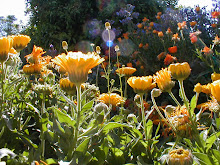
Growing "organically" as the term was coined in the 1940's in England and 1960's in the US, originally meant supporting the whole ecosystem that plants thrive and develop most naturally in, primarily by building the soil using natural (not synthetic) amendments like compost and manures. It also meant not using high doses of isolated chemicals such as synthetic nitrogen to superficially boost plant growth at the expense of plant health and nutrition or the health of the farm ecosystem as a whole. In principle, it meant that when farmers supported the health of the environment that plants grew in, the result would be the healthiest and most nutritious plants.
Since federalization of the National Organic Standards, the word "organic" has now become a legal term indicating compliance with USDA National Organic Program standards developed and regulated generally with large agribusiness in mind. Now, farmers cannot use the term "organic" in its original sense without legal ramifications. This in effect has changed the implications of the term "organic" for those who grow your vegetables and herbs according to the above principles which are among the same general practices that the organic standards aim to enforce.
For clarification, we grow all naturally (using only soil amendments that at least would be USDA Certified Organic) but are not pursuing "USDA Organic Certification". All natural means we only use "organic" fertilizers in the form of fish and seaweed emulsion, prepared manures, and compost. Pest control is mainly mechanical, for example, row covers over emerging seedlings until they are big enough to outgrow any pest damage. Our experience has been that pests take over only when plants and soil are unhealthy, or the crop is simply done for the season. We respect the natural cycle of the plant. Our focus is supporting biodiversity and contributing to the saving of endangered varities by favoring heirloom and open pollinated varieties, and growing wholistically by integreting organic and biodynamic (see
http://www.biodynamics.com/biodynamics.html and co-creative science techniques (see http://www.perelandra-ltd.com/Co_Creative%20Excerpt_W34.cfm ). We're happy to provide more info at your request.
This from Matthew Moore: I also am the manager of my family's conventional farm which surrounds the all natural parcel. In regards to the pesticide and herbicide use surrounding the 2 acres it is something we take very seriously. We are not certified through the USDA. We aim to grow at and above their standards. For example, the USDA along with the other 15 organizations which you can be certified through require a minimum of 30 feet of distance between the organic and conventional crops, we are well outside of that measurement. That being said, I am not very comfortable with the magical 30 feet of air that is supposed to diffuse anything put down on those opposing field, so as a farm manager I demand that nothing be sprayed within 100" of the field as well as stopping spraying with any wind drift conditions that may endanger soil or crops. I also plan for the placement of crops around the all natural field which use little to no pesticides and herbicides, ie: radishes. (being a short-term crop those 'tools' are not as necessary). We do not use any weed control on the surrounding ditches other than a hoe or a tractor disc. We take these concerns very seriously and appreciate your taking the time to ask about these issues.
Monday, July 14, 2008

Sunday, July 13, 2008
What if I can't eat all those vegetables?
From my own experience as a former CSA member and from the feedback we have received so far from our members, I can relate to you the likelihood that, as members, your family will be eating more vegetables than you are currently. At first this may be challenging, perhaps even overwhelming. To support you, we offer a blog with recipes we post and a world wide web chock full of infinite more recipes at your fingertips!
Currently, members who do not eat their full share have creatively "split" their share with another person or family either by previous arrangement or informally by offering, that is, "sharing" items from their share with an extended family member, neighbor, co-worker, friend or someone who would otherwise not have access to such healthful food. This is another way of expressing and experienceing the "Community" aspect inherent to Community Supported Agriculture and members who have done so have almost exclusively found it to be rewarding and fun.
Currently, members who do not eat their full share have creatively "split" their share with another person or family either by previous arrangement or informally by offering, that is, "sharing" items from their share with an extended family member, neighbor, co-worker, friend or someone who would otherwise not have access to such healthful food. This is another way of expressing and experienceing the "Community" aspect inherent to Community Supported Agriculture and members who have done so have almost exclusively found it to be rewarding and fun.
Saturday, July 12, 2008
What is Biodynamics?
Excerpted from The Biodynamic Farming & Gardening Association website
In the early 1920's a group of practicing farmers, concerned with the decline of the soil, sought the advice of Dr. Rudolf Steiner, founder of anthroposophy, who had spent all his life researching and investigating the forces that regulate life and growth. From a series of lectures and conversations held at Koberwitz, Germany, in June 1924, there emerged the fundamental principles of biodynamic farming and gardening, a unified approach to agriculture that relates the ecology of the earth-organism to that of the entire cosmos. This approach has been under development in many parts of the world ever since. Dr. Ehrenfried Pfeiffer, who worked with Dr. Steiner during the formative period, brought biodynamic concepts to the United States in the 1930s. It was during this period that the Biodynamic Farming and Gardening Association was founded in 1938.
Essentially, biodynamic farming and gardening looks upon the soil and the farm as living organisms. It regards maintenance and furtherance of soil life as a basic necessity if the soil is to be preserved for generations, and it regards the farm as being true to its essential nature if it can be conceived of as a kind of individual entity in itself — a self-contained individuality. The maintenance of soil life is vital also in order to protect the soil from erosion and to create, improve, and augment the humus content. The result will be a fine, crumbly structure containing the necessary organic colloids. This leads to the production of high-quality crops, which in turn means better feed for livestock and better food for human beings. Soil improvement is obtained by proper humus management. For example, by the application of sufficient organic manure and compost in the best possible state of fermentation; by proper crop rotation; by proper working of the soil; by protective measures such as wind protection; cover crops, green manure, and diversified crops rather than monocultures; and by mixed cropping so that plants can aid and support each other.
Complicated fermentation processes must first take place in the manure heap. The biodynamic method produces the right fermentation. Certain biodynamic preparations are inserted into the heaps in order to speed and direct fermentation and preserve the original manure values. The biodynamic compost preparations play a significant role in this unified approach to agriculture. They are made of certain medicinal herbs that have undergone a long process of fermentation in order to enrich them in growth-stimulating substances. They react like yeast in dough. That is, they speed and direct fermentation toward the desired neutral colloidal humus. The preparations themselves are...applied to the manure and compost piles in very small quantities. They have no manuring effect, their sole purpose being to direct the fermentation of any kind of organic matter toward humus. Two of the preparations are used as field sprays. They are diluted in water, stirred for a period to potentize, and sprayed directly on the soil to aid humus formation and the growth of roots, or to the green leaves of plants themselves.
Proper crop rotation is also necessary in order to preserve the fertility of the soil. Proper working of the soil consists mainly in knowing the right time and the right depth for plowing, harrowing, discing, etc. Skill and experience are needed. Only thoughtful experience, combined with such investigations as the taking of soil profiles, can produce maximum efficiency in soil treatment.
Biodynamic agriculture is a way of living, working and relating to nature and the vocations of agriculture based on good common-sense practices, a consciousness of the uniqueness of each landscape, and the inner development of each and every practitioner. Common-sense practices include striving to be self-sufficient in energy, fertilizers, plants, and animals; structuring our activities based on working with nature's rhythms; using diversity in plant, fertilizers, and animals as building blocks of a healthy operation; being professional in our approach to reliability, cleanliness, order, focus on observation, and attention to detail; and being prompt and up-to-date in doing one's job. The concern with the uniqueness of a particular landscape includes developing an understanding of the geology, soils, climate, plant, and animal life; human ecology; and economy of one's bioregion.
Rudolf Steiner presents a notion of science that says we can know things that go beyond what we can weigh, measure, and calculate. Science is the practice of observing phenomena and relating them in a way that correctly represents the phenomena's reality. Agricultural judgments about health, what to do where, and when to do what, best succeed when we begin to rely on a certain wisdom gained through observation and experience and when we perceive consciously and concretely the phenomena that induce life itself.
Biodynamic farming and gardening combines common-sense agriculture, an understanding of ecology, and the specific environment of a given place with a new spiritual scientific approach to the concepts, principles, and practices of agriculture.
In the early 1920's a group of practicing farmers, concerned with the decline of the soil, sought the advice of Dr. Rudolf Steiner, founder of anthroposophy, who had spent all his life researching and investigating the forces that regulate life and growth. From a series of lectures and conversations held at Koberwitz, Germany, in June 1924, there emerged the fundamental principles of biodynamic farming and gardening, a unified approach to agriculture that relates the ecology of the earth-organism to that of the entire cosmos. This approach has been under development in many parts of the world ever since. Dr. Ehrenfried Pfeiffer, who worked with Dr. Steiner during the formative period, brought biodynamic concepts to the United States in the 1930s. It was during this period that the Biodynamic Farming and Gardening Association was founded in 1938.
Essentially, biodynamic farming and gardening looks upon the soil and the farm as living organisms. It regards maintenance and furtherance of soil life as a basic necessity if the soil is to be preserved for generations, and it regards the farm as being true to its essential nature if it can be conceived of as a kind of individual entity in itself — a self-contained individuality. The maintenance of soil life is vital also in order to protect the soil from erosion and to create, improve, and augment the humus content. The result will be a fine, crumbly structure containing the necessary organic colloids. This leads to the production of high-quality crops, which in turn means better feed for livestock and better food for human beings. Soil improvement is obtained by proper humus management. For example, by the application of sufficient organic manure and compost in the best possible state of fermentation; by proper crop rotation; by proper working of the soil; by protective measures such as wind protection; cover crops, green manure, and diversified crops rather than monocultures; and by mixed cropping so that plants can aid and support each other.
Complicated fermentation processes must first take place in the manure heap. The biodynamic method produces the right fermentation. Certain biodynamic preparations are inserted into the heaps in order to speed and direct fermentation and preserve the original manure values. The biodynamic compost preparations play a significant role in this unified approach to agriculture. They are made of certain medicinal herbs that have undergone a long process of fermentation in order to enrich them in growth-stimulating substances. They react like yeast in dough. That is, they speed and direct fermentation toward the desired neutral colloidal humus. The preparations themselves are...applied to the manure and compost piles in very small quantities. They have no manuring effect, their sole purpose being to direct the fermentation of any kind of organic matter toward humus. Two of the preparations are used as field sprays. They are diluted in water, stirred for a period to potentize, and sprayed directly on the soil to aid humus formation and the growth of roots, or to the green leaves of plants themselves.
Proper crop rotation is also necessary in order to preserve the fertility of the soil. Proper working of the soil consists mainly in knowing the right time and the right depth for plowing, harrowing, discing, etc. Skill and experience are needed. Only thoughtful experience, combined with such investigations as the taking of soil profiles, can produce maximum efficiency in soil treatment.
Biodynamic agriculture is a way of living, working and relating to nature and the vocations of agriculture based on good common-sense practices, a consciousness of the uniqueness of each landscape, and the inner development of each and every practitioner. Common-sense practices include striving to be self-sufficient in energy, fertilizers, plants, and animals; structuring our activities based on working with nature's rhythms; using diversity in plant, fertilizers, and animals as building blocks of a healthy operation; being professional in our approach to reliability, cleanliness, order, focus on observation, and attention to detail; and being prompt and up-to-date in doing one's job. The concern with the uniqueness of a particular landscape includes developing an understanding of the geology, soils, climate, plant, and animal life; human ecology; and economy of one's bioregion.
Rudolf Steiner presents a notion of science that says we can know things that go beyond what we can weigh, measure, and calculate. Science is the practice of observing phenomena and relating them in a way that correctly represents the phenomena's reality. Agricultural judgments about health, what to do where, and when to do what, best succeed when we begin to rely on a certain wisdom gained through observation and experience and when we perceive consciously and concretely the phenomena that induce life itself.
Biodynamic farming and gardening combines common-sense agriculture, an understanding of ecology, and the specific environment of a given place with a new spiritual scientific approach to the concepts, principles, and practices of agriculture.
Friday, July 11, 2008
What kinds of vegetables will I receive?
We are eager to plant as many vegetables that grow in any one short desert season as we can manage with our acreage, propagation space, time and labor resources. However, our planting list is not always our harvest list as some crops do well while others may not, such is the risk a farmer and a CSA member takes! You may scroll down the Harvests page in our blog at www.wholeearthcsaharvests.blogspot.com to view the contents of members' weekly shares throughout the season for a realistic idea of what we were actually able to harvest for people thoughout each season. In each season typically, some crops that take the longest to mature will only be ready for harvest toward the end of the 10 week delivery session.
We focus our plantings on rare and Heirloom varieties and minimize our dependence on hybrid varieties. This supports biodiversity by creating a demand for seeds of plant varieties that may otherwise become extinct through a lack of growers. A great many of our varieties come from seeds found through obscure and ancient sources during growers travels in other countries. This all translates to an opportunity for members to enjoy the uniqueness, beauty, variety and nutrition of vegetables from around the world not commonly found at the grocers.
We focus our plantings on rare and Heirloom varieties and minimize our dependence on hybrid varieties. This supports biodiversity by creating a demand for seeds of plant varieties that may otherwise become extinct through a lack of growers. A great many of our varieties come from seeds found through obscure and ancient sources during growers travels in other countries. This all translates to an opportunity for members to enjoy the uniqueness, beauty, variety and nutrition of vegetables from around the world not commonly found at the grocers.
Thursday, July 10, 2008
Why do members commit for the whole season?
CSA's operate differently from retail buying situations because a farmer must plan the season for a certain number of members, each being offered a share of the harvest which is grown specifically for them. Planting of course, needs to happen several months in advance of harvest (in fact, I am preparing to plant now in July for harvest in fall). So as you can see, the investment on the part of the farmer is a long-term one, even longer than the purchaser of the share.
A CSA applies the term "member" consciously because it indicates a commitment on the part of the person buying the share and the farmer who grows for them. Because, there is a limited number of shares available determined by labor and land restraints, I would have to essentially commit a whole share for the whole season and turn away another who would be interested in commiting to the whole season in order to allow someone to sample a bag for one week. In essence, this is why without each member's prior commitment for the whole season, I cannot plan successfully for the whole CSA membership.
A CSA applies the term "member" consciously because it indicates a commitment on the part of the person buying the share and the farmer who grows for them. Because, there is a limited number of shares available determined by labor and land restraints, I would have to essentially commit a whole share for the whole season and turn away another who would be interested in commiting to the whole season in order to allow someone to sample a bag for one week. In essence, this is why without each member's prior commitment for the whole season, I cannot plan successfully for the whole CSA membership.
Subscribe to:
Posts (Atom)